Bouygues Wins Contract for New Jersey Hospital Project
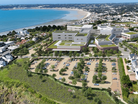
The government of Jersey has chosen France-based infrastructure giant, Bouygues, as the preferred bidder for its new Overdale Acute Hospital.
It is part of a £710m (US$943m) project, which includes another two major sites at St Saviour Health Village and the Kensington Place ambulance facility.
The hospital, which will cover a total area of 47,500m, is a crucial part of the island’s New Healthcare Facilities Programme.
Philippe Bernard, Chair and CEO of Bouygues UK, says: "We are excited to deliver this transformational project for Jersey.
“The partnership with the Government of Jersey and the New Healthcare Facilities Programme team to reach this point has been extremely collaborative and productive, and we look forward to working together to deliver exceptional value, support local employment and supply chain partners, and create lasting social benefits for the community throughout construction and beyond.
“As Lead Contractor, we are committed to bringing our healthcare expertise and project management capabilities to ensure the successful delivery of this vital facility for Jersey."
The plan for the new Jersey Hospital

Overdale Acute Hospital will include an Emergency Department, six operating theatres, inpatient beds, intensive care beds and a mother and baby unit.
The site is expected to require around 800 workers at peak construction time.
Sustainability considerations underpin the design which incorporates low-carbon and energy efficiency materials and aims to deliver a biodiversity net gain of more than 10%.
Bouygues’ track record in the healthcare sector
The new Jersey hospital is one of many projects Bouygues Construction has undertaken in the healthcare sector in the past decade.
It has completed more than 300 healthcare facilities, across the UK and other regions.
These include the Moorfields and UCL Centre for Eye Health and the Proton Beam Therapy Centre in the UK, Trousseau University Hospital in France and the Mohammed VI International University Hospital in Morocco.
In June, Bouygues Bâtiment International, a subsidiary of Bouygues Construction, announced that it had won the contract to design and build a new university hospital in Montenegro’s capital, Podgorica. It will be on the existing Clinical Centre of Montenegro site, and attached to the University of Montenegro Faculty of Medicine,
The 562 hospital-bed complex will include a fully equipped surgical unit, 117 intensive care units, five theatres for children and 14 for adults, an accident and emergency department, laboratory research facilities and amenities for teaching and medical training.
It will be constructed in stages, beginning in 2027, subject to financial close.
Meeting environmental and seismic standards
The new Montenegro hospital will meet a number of environmental standards, including the Leadership in Energy and Environmental Design (LEED) Silver environmental certification.
LEED is a global building certification program established by the US Green Building Council. It rates a building’s sustainability across its construction, design and operations.
The hospital will also meet nearly zero-energy building (NZEB) standards, which requires a building to generate its energy from renewable sources on site or nearby. It has a target of a 10% reduction in energy consumption compared to national NZEB thresholds.
Bouygues will also ensure the hospital is constructed in line with strict seismic standards. For example, it will use post-tensioned slabs to ensure the building’s longevity.
Some 700 workers are expected to occupy the site at peak construction. The Clinical Centre of Montenegro will remain in operation throughout the project.
Philippe Jouy, CEO of Bouygues Bâtiment International, said: “This is an ambitious project that will directly benefit the residents of this country as well as the wider region.
“In close collaboration with our client and partners, we are committed to creating a high-performance university hospital that will support changes in healthcare practices, teaching and research in Montenegro for many years to come.”
Company portals

Executives

Philippe BERNARD
CEO & Chair
Philippe Jouy
Deputy CEO of Bouygues Construction, leading International Building Division