Caterpillar and FieldAI Drive Physical AI Forward
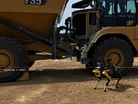
Caterpillar has entered a collaboration with FieldAI to advance physical AI, autonomy and robotics across jobsites and manufacturing facilities.
Their goal is to help industries facing labour shortages and rising productivity demands operate more safely and efficiently.
By turning real-time observations into actionable insights, the partnership combines Caterpillar's engineering expertise and operational data with FieldAI's AI-enabled robot foundation models, building on a vision for the "jobsite of the future" that Caterpillar first shared earlier in 2026.
Physical AI meets heavy industry
The collaboration is central to how the company sees its industries evolving.
"The future of our industries will be shaped by how effectively we combine human expertise with AI-powered machines,” says Jaime Mineart, Caterpillar's Chief Technology Officer. “Collaborations like this help accelerate the journey. We're focused on applying AI where it matters most, helping customers improve safety, increase productivity and get more value from every operation."
Caterpillar selected FieldAI for its ability to deploy in complex, dynamic industrial environments where traditional automation has often fallen short.
FieldAI's robot-agnostic autonomy and foundation models are designed to turn large volumes of operational and jobsite data into actionable insights, complementing Caterpillar's manufacturing modernisation and jobsite of the future initiatives.
The two companies have identified early applications such as:
- Autonomous inspections to improve safety and operational visibility
- Jobsite and facility digital twins offering real-time insights into equipment and operations
- Enhanced situational awareness to identify risks sooner and support faster decisions
- Operational optimisation through simulation, automation and AI-driven insights

Together, we are shaping the next century of AI-enabled heavy industry
Three decades of autonomous testing
The collaboration builds on autonomy work that Caterpillar says stretches back more than 30 years, beginning with a partnership with Carnegie Mellon University in the 1980s.
They collaborated on developing software, GPS and perception systems leading to Caterpillar's first autonomous truck tests.
Through the 1990s and 2000s, the company advanced sensing, positioning and control capabilities, and real-world testing under extreme conditions.
They became one of the first manufacturers to deliver Level 4 autonomy – machines capable of operating independently.
Since Caterpillar's autonomy journey began, its autonomous mining fleet has safely moved over 11 billion tonnes of material and has travelled more than 380 million kilometres.
"Caterpillar has shaped operations on jobsites and manufacturing facilities for over a century, and these are exactly the environments FieldAI excels in, with deployments spanning hundreds of sites worldwide,” says Ali Agha, Founder and CEO of FieldAI. “This collaboration brings leading physical AI capabilities to a leading manufacturer of construction and mining equipment. Together, we are shaping the next century of AI-enabled heavy industry."
FieldAI has raised over US$400m in funding to develop its technology.
Building the jobsite of tomorrow
Leveraging NVIDIA accelerated computing, NVIDIA Omniverse technologies and high-fidelity digital twins built from operational data, Caterpillar says the collaboration improves site visibility, accelerates decision-making and supports the next generation of industrial operations.
Integrated LiDAR, radar, GPS and high-resolution cameras are intended to provide a constantly updated digital view of jobsites, enabling autonomous operations even in complex and chaotic environments.
Caterpillar's key partners:
FieldAI
A general-purpose robotics company providing frontier autonomy software as a universal "brain" across many robots and tasks. Its Field Foundation Models combine data-driven AI with physics-based reasoning and uncertainty awareness, enabling deployment in unstructured environments. The company has raised over US$400m from investors including Bezos Expeditions, Khosla Ventures and NVIDIA's venture arm, NVentures.
NVIDIA
This technology giant supports the Caterpillar and FieldAI collaboration through accelerated computing and its Omniverse technologies, which underpin high-fidelity digital twins built from operational data. Caterpillar leverages these tools to improve jobsite visibility and decision-making, extending an existing relationship the company deepened around AI use in the mining sector earlier in 2026.
Carnegie Mellon University
This private research university in Pennsylvania in the US, has been a Caterpillar partner since the 1980s, when the two organisations developed early software, GPS and perception systems. That work led to Caterpillar's first autonomous truck tests and laid the technical foundation for the sensing, positioning and control capabilities used across its autonomous fleets today.
Company portals




Executives
Jaime Mineart
Chief Technology Officer and Senior Vice President