Hitachi’s Physical AI Project Focusing on Excavators
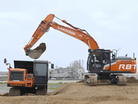
Labour shortages, punishing site conditions and the growing urgency of disaster response are pushing construction and mining equipment makers to rethink what "automation" means.
Rather than scripting fixed movements, Hitachi Construction Machinery is developing what it calls Physical AI: systems trained directly on the lever operations, camera footage and work instructions of human excavator operators, so machines can interpret site conditions and make their own operating decisions.
The approach targets some of the industry's toughest applications, from debris clearance at disaster sites to excavation and loading at construction and mining operations, and reflects a broader industry shift toward AI that understands physical environments rather than simply automating repetitive tasks.
We will combine Hitachi Construction Machinery's equipment expertise with advanced automation technologies to provide customers with greater flexibility and options in adopting automation solutions
- Hitachi Construction Machinery employs roughly 25,000 people worldwide
- Consolidated sales revenue reached ¥1,405.5bn (US$9.16bn) for the most recent reported fiscal year
- Overseas sales accounted for 84% of that revenue
- The company operates across new machinery sales alongside parts, servicing, remanufacturing, rental and used equipment
- Hitachi Construction Machinery plans to transition its trade name and corporate brand to LANDCROS Corporation
Training AI on operator expertise
Conventional automation in heavy equipment has typically relied on pre-programmed routines suited to predictable, repetitive tasks.
Physical AI is a different proposition. It is designed to recognise real-world conditions and autonomously make decisions and take action, a capability increasingly applied across industrial and humanoid robotics as well as construction machinery.
For hydraulic excavators, that means building a system capable of three linked functions: understanding the surrounding environment, optimising a work plan and executing the operation.
Hitachi Construction Machinery is collecting extensive operator footage and operation logs, spanning routine tasks as well as recovery from operational errors, changing weather, varying machinery conditions and object positioning, to train the underlying model on the full diversity of conditions a real site can present.
"We have worked alongside customers around the world and have developed a deep understanding of their diverse needs and the challenges they face. We will combine Hitachi Construction Machinery's equipment expertise with advanced automation technologies to provide customers with greater flexibility and options in adopting automation solutions," says Masafumi Senzaki, President and Executive Officer of Hitachi Construction Machinery, commenting on the company's wider drive toward autonomous, AI-enabled equipment.
Built through industry-academia collaboration
Physical AI development of this kind depends on more than machinery expertise alone; it requires specialist capability in data utilisation, AI training environments and foundation model research.
Hitachi Construction Machinery has structured the programme as a three-way collaboration, with each partner responsible for a distinct part of the effort:
- Hitachi Construction Machinery leads overall coordination, collects hydraulic excavator operational data, and builds and verifies the research and development environment
- Jizai, Inc. researches the data utilisation technologies and training environment required for AI development
- Nara Institute of Science and Technology (NAIST) researches and develops the Physical AI foundation model for autonomous excavator operation
The programme has been selected under Japan's GENIAC framework, a national initiative promoted by the Ministry of Economy, Trade and Industry and the New Energy and Industrial Technology Development Organization (NEDO).
The initiative sits within NEDO's Robotics Foundation Model R&D Project, which also supports development work on multipurpose robots.
That structure mirrors a pattern seen across the industry of heavy equipment manufacturers increasingly pairing their own operational data and domain expertise with external AI specialists and academic researchers, rather than attempting to build foundation-model capability entirely in-house.

A wider push toward autonomy
The excavator programme is one strand within a broader autonomy strategy that spans Hitachi Construction Machinery's construction and mining businesses, from operator-assist AI tools to autonomous haulage partnerships in mining.
It is not the only company to announce a Physical AI push recently. Caterpillar has entered a collaboration with FieldAI to advance autonomy, robotics and physical AI, across jobsites and manufacturing facilities.
Hitachi Construction Machinery has framed its new programme as central to its evolving brand identity and customer proposition.
"It is based on a partnership philosophy, working openly with technology leaders, integrating cutting-edge digital and AI capabilities into machines that symbolise reliability in the construction industry, whilst creating a reimagined customer experience from ground to cloud," says Francesco Quaranta, President and CEO of Hitachi Construction Machinery Europe.
Hitachi Construction Machinery's key business partners:
Jizai
A Tokyo-based technology company led by Representative Director and CEO Yuki Ishikawa. Within the Physical AI programme, Jizai is responsible for researching the data utilisation technologies and training environments required to develop AI models, applying expertise gained from supporting AI adoption in robotics and machinery across other industrial sectors.
Nara Institute of Science and Technology (NAIST)
An academic research institution contributing foundation model expertise to the programme. NAIST leads research and development of the Physical AI foundation model underpinning autonomous hydraulic excavator operation, providing the academic research capability that complements Hitachi Construction Machinery's industrial data and engineering expertise.
Pronto
A San Francisco-based autonomous technology company, led by CEO and Co-Founder Anthony Levandowski. It specialises in original equipment manufacturer-agnostic Autonomous Haulage Systems for mining. Hitachi Construction Machinery has signed a memorandum of understanding with Pronto to advance open mine automation solutions, aiming to give mining customers greater flexibility in adopting autonomy.
Rithmik Solutions
A Canadian AI analysis company in which Hitachi Construction Machinery has invested to strengthen mining operations technology. The collaboration explores applying Rithmik's AI-driven analysis to Hitachi's operational data platforms, enabling equipment reference values to be set from live operating conditions rather than static design benchmarks.
Yanmar Holdings
A Japanese equipment manufacturer that has signed a letter of intent with Hitachi Construction Machinery to explore collaboration in the compact equipment business. The agreement reflects Hitachi Construction Machinery's pattern of pursuing structured partnerships to broaden its technology and product capabilities across adjacent equipment categories.
Company portals






Executives
Francesco Quaranta
President & CEO
Masafumi Masuda
Senior Vice President, Head of Radio Access Network Design Department