
How Bechtel and Turner Are Digitising Jobsite Safety
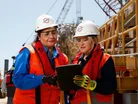
Construction remains one of the most dangerous industries in the world. According to data compiled by the US Bureau of Labour Statistics (BLS), around 20% of all worker fatalities in the US occur among construction workers, despite the sector representing only 6% of the labour force.
Against that backdrop, major contractors are moving away from paper-based hazard processes toward digital and AI tools that can surface risks in real time.
Four of the sector's largest builders, Bechtel, Turner Construction, Skanska and Balfour Beatty, have all made significant moves in this direction, each taking a different approach to the same underlying problem.
Bechtel's paper-to-digital shift
Bechtel, one of the world's largest engineering, procurement and construction firms, developed its Digital Field Level Hazard Analysis app that makes real-time updates as conditions change and automatically save records.
The tool was deployed at one of the largest semiconductor plant construction projects in the US, where teams previously relied on paper forms every morning before work began.
Voice-to-text capability allows crew members to describe hazards verbally with their gloves on, and they can take a photo of what they are seeing and the app will identify the risks.
Guided workflows ensure nothing critical is skipped, while geo-location technology displays completed assessments on a live site map. This allows supervisors to see where active hazards have been flagged and direct oversight where it is needed most.
The app also integrates with Bechtel's training and qualification data. Before work begins, supervisors can see whether crew members hold the certifications required for their assigned tasks, including whether training records are outdated or expired.

Turner's SafeT Coach AI app
Turner Construction, the largest contractor in the US in terms of revenue, took the further step of making its own AI safety tool available to the wider industry at no cost.
SafeT Coach acts as a virtual safety consultant, where users can ask plain-language questions and receive answers based on Turner's environmental, health and safety framework. The tool can also evaluate uploaded jobsite photos, flag potential hazards, prioritise risk and recommend controls in real time.
Since its pilot deployment, SafeT Coach has logged more than 25,000 interactions with Turner staff, trade partners and field teams, according to Turner. The tool runs inside OpenAI's ChatGPT environment, with a version built on Google's Gemini platform in development.
"Nothing we build will ever be as important as the people who build it," says Stephen Spaulding, Turner's Chief Environmental, Health and Safety Officer.
Skanska's Safety Sidekick
Skanska has built its own generative AI tool, known as the Safety Sidekick, which draws on the company's EHS Manual, OSHA construction standards and supplemental safety documentation. The contractor currently uses it primarily for planning, although it also has reactive applications.
Brian Karas, National Environmental Health and Safety Director for Skanska USA Building, says: "It doesn't leap out your phone and tell you to get off the ladder, but it definitely gives us a leg up in terms of learning from this wealth of information."
The Safety Sidekick sits within Skanska's broader family of proprietary AI tools, known collectively as Sidekicks. Skanska and Balfour Beatty have been developing AI applications across construction operations since 2024.
Balfour Beatty's Microsoft deployment
Balfour Beatty has deployed a Microsoft AI system within the company's own firewall to experiment with safety and project use cases. The London-based contractor has framed the move as part of a response to both safety and productivity pressures.
Leo Quinn, who served as Balfour Beatty's Chief Executive Officer until September 2025, pointed to technology as essential for addressing the construction labour shortage.
"We have a real skills challenge in the industry and if we are to have any chance of actually delivering all the work that is out there we have got to use technology to make people more productive," Leo told investors.
"And at the same time, we make them safer and better assured in what they are doing."
Balfour Beatty reported a record order book of £22.7bn (US$28.7bn) for 2025, a 23% increase on the prior year, with major programmes across the US and UK driving pipeline growth.

Why the shift is accelerating
According to the US National Safety Council, companies save between US$4 and US$6 for every US$1 invested in workplace safety programmes. It also reports that construction fatalities average US$1.46m each in associated costs, while the average medically consulted injury costs US$40,000.
Technology that is purpose-built for the jobsite gives the industry the tools to bring those figures down. The paper-based systems these platforms are replacing could not.
Company portals

Executives

Leo Quinn
Strategic Advisor to the Board

Stephen Spaulding
Chief Environmental, Health and Safety Officer.