How Schneider Electric AI Extends Equipment Life for Holcim
“Motors are at the heart of industrial operations, when they stop, everything stops,” writes Ionut Farcas, President Central Eastern Europe at Schneider Electric.
Holcim Romania has formed a strategic partnership with Schneider Electric to improve how essential machinery is monitored and maintained on site.
Rather than relying on the traditional reactive method of repairing machinery only after failure, Holcim Romania now uses Schneider Electric’s EcoStruxure Service Plan for Rotating Equipment.
This predictive maintenance system uses connected sensors and artificial intelligence to monitor the performance of key assets.
The sensors, installed on power lines, feed operational data into algorithms that analyse performance in real time.
The system’s insights help Holcim avoid unplanned stoppages, reduce wear on machinery and extend the life of critical components.
These benefits translate directly into improved uptime and more reliable day-to-day operations.
Fewer equipment failures mean reduced waste, less energy usage and a more efficient operation overall.
Embedding technology
Sustainability is embedded in Holcim’s global approach to construction and material supply.
The group’s 2030 and 2050 net zero targets, which have been validated by the Science Based Targets initiative (SBTi), cover emissions from direct operations, energy use and supply chain activity.
Holcim Romania plays a role in delivering on these targets through several key actions:
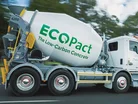
Increasing the share of low-carbon building materials, aiming for 50% of net sales to come from ECOPlanet cement and ECOPact ready-mix concrete by 2030
Advancing circular construction methods, including the use of 20 million tonnes of recycled materials through its ECOCycle platform
Bringing down emissions to under 400 kg of CO₂ per tonne of cementitious material
Reducing freshwater use by a third, compared with 2020 levels, to safeguard natural ecosystems
Digital monitoring tools like EcoStruxure help to enforce these practices by optimising energy use and limiting resource waste.
“With our sustainable building solutions, Holcim is committed to building cities that work for all,” says Nollaig Forrest, Chief Sustainability Officer at Holcim, in the company’s 2024 Climate Report.
“With our seven large-scale carbon capture projects in Europe, engineered to produce eight million tons of net zero cement per annum by 2030, we are on track to make net zero cement and concrete a reality at scale this decade.”
Supporting low-emission urban infrastructure
Holcim Romania has supplied materials and support for key infrastructure schemes, such as the Bucharest Metro M5 line.
This is a 7km expansion designed to serve the densely populated Drumul Taberei area.
Expected to accommodate around 50,000 daily passengers, the new metro line addresses congestion and urban emissions.
Holcim delivered both standard and specialist concretes, plus large quantities of cement used in stabilising the soil.
Work was carried out in high-traffic locations under strict delivery timelines, often running 24 hours a day.
In addition to materials, Holcim provided technical advice, on-site support and laboratory testing throughout the construction process.

Digital energy solutions deliver added value
Schneider Electric says that 80% of its revenues align with sustainable impact goals and its solutions have helped customers avoid or reduce 800 million tonnes of CO₂ emissions to date.
EcoStruxure, Schneider’s flagship digital platform, is central to this contribution.
It helps construction operators and manufacturers monitor energy usage, extend equipment lifespans and shrink carbon emissions.
These outcomes align with several global climate commitments including the UN Sustainable Development Goals and initiatives like EP100 (energy productivity), RE100 (renewable electricity) and EV100 (electric vehicles).
Schneider also supports energy transition by offering renewable certificates, on-site generation solutions, green tariffs and long-term power purchase agreements.