Komatsu and AIM Harness Autonomy Tech to Improve Output
Historically, the construction industry is known as a slow adopter of new technology.
However, this truth is now jarring with another: output is not meeting demand.
McKinsey & Company has found that construction output may fail to meet demand by up to a considerable US$40bn cumulatively by 2040.
Meanwhile, it has also discovered that the Architecture, Engineering, and Construction industry could unlock around US$228bn in annual value in the United States through automation technology.
It is this type of technology that industrial equipment powerhouse Komatsu has been developing in partnership with AIM Intelligent Machines (AIM), a manufacturer of autonomous operation technology for bulldozers and hydraulic excavators.
Tackling productivity, labour and safety issues

The two companies’ autonomous construction solutions target the US and Japanese markets.
They are designed to help with the increasing demand for infrastructure while improving industry-wide challenges such as safety, productivity and labour shortage levels.
“Komatsu is committed to working together with the industries we serve to work toward safe, productive and sustainable jobsites through construction equipment and digital solutions. AIM shares our vision of transforming construction through autonomous technology, making them an ideal partner for this journey,” says Chikashi Shike, President of Komatsu’s Solution Division.
Komatsu and AIM’s collaboration: a powerful pairing
Both companies are already accomplished in their own right within the technology arena.
Komatsu, and its subsidiary EARTHBRAIN, offer a digital construction management solution that connects planning, jobsite management, digitally enabled equipment and remote planning.
AIM is a provider of autonomy technology powered by physical AI – AI which requires sensors and actuators on machines to move, manipulate its surroundings and adapt to unpredictable environments.The company has already deployed fleets of equipment.
“We have deep respect for Komatsu’s construction equipment, refined through more than a century of engineering excellence. By combining AIM’s physical AI platform with Komatsu’s ecosystem, construction machines can autonomously perform earthmoving tasks at the jobsite,” says Adam Sadilek, CEO of AIM Intelligent Machines.
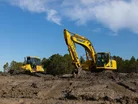
The partnership between the two companies has seen autonomous bulldozers and hydraulic excavators commercially deployed across numerous jobsites in the US. The same is planned for the Japanese market.
Integrating automation throughout the construction process
The solution merges smart construction-generated construction plans and target terrain information with AIM’s physical AI platform to produce autonomous operation.
For the bulldozers and excavators, this means they can process project objectives, determining construction methods and routes for moving around a site autonomously.
As for customers, it is created to help them manage each part of the construction process. From planning to visualising processes, Komatsu says it can all be executed through a single digital workflow.
“Through this partnership, we will integrate Smart Construction with AIM’s technology to create a seamless connection from construction planning and management to autonomous execution, accelerating the optimisation of entire jobsites,” explains Chikashi.
The technology can be retrofitted to legacy equipment, allowing companies to upgrade current fleets rather than acquire new ones.
“This partnership enables organisations to make a smooth transition from conventional operations to autonomous construction while continuing to utilise their existing equipment fleets,” says Adam.
Company portals


Executives
Adam Sadilek
Founding CEO
Chikashi Shike
常務執行役員 ソリューション本部長