
Middle East Conflict Drives UK Construction’s Solar Surge
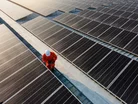
Rising energy costs triggered by the US-Israel war on Iran are pushing construction companies to accelerate solar panel installations on commercial buildings and project sites, as the industry seeks to control spiralling operational expenses.
Construction sector faces renewed energy pressure
The construction industry is confronting a familiar threat. Escalating conflict in the Middle East is driving energy prices upward, forcing construction companies and commercial property developers to reassess their approach to power generation and site energy costs.
According to market analysts, since the US and Israel launched joint airstrikes on Iran at the end of February 2026, around one fifth of the world's gas and oil has been effectively removed from circulation. Markets and stock exchanges have already reacted, with fuel prices rising significantly according to commodity trading data.
For construction firms still managing the financial aftermath of the 2022 energy crisis triggered by Russia's invasion of Ukraine, site operations, equipment running costs and the energy demands of commercial building projects are all facing renewed pressure as wholesale prices climb.

Construction firms accelerate solar adoption
New data from renewable energy specialist Glow Green reveals that demand for solar panels has surged 182% year on year, a spike that directly mirrors the escalating tensions in Iran.
Construction companies and commercial property developers are leading this charge, recognising that volatile grid electricity prices pose a significant risk to project budgets and long-term operational costs.
"With global tensions rising and the situation in Iran putting pressure on fuel and energy prices, we may be on the brink of another shift in the UK's renewable energy market," says Lloyd Greenfield, Founder of Glow Green.
For construction sites running power-hungry equipment and commercial building projects designed for long-term occupancy, the arithmetic is increasingly compelling.
Installing solar capacity during construction or retrofit projects could mean decades of reduced energy exposure for building owners and tenants.
Lloyd draws an instructive comparison to the previous crisis. "During the Ukraine conflict, rising wholesale gas prices led many homeowners to seek renewable alternatives, triggering an unexpected solar panel shortage across the UK," he explains.
"If current trends continue, we could see a similar pattern emerge again where growing demand for solar panels outpaces supply."
The post-Ukraine rush on solar panels caught many consumers off guard, leaving some projects waiting months for installation.
Lloyd warns the same could happen again, and sooner than people expect, potentially disrupting construction timelines and commercial development schedules.
Supply chain challenges threaten installations
What makes this moment particularly complex for the construction sector is that the war is not only pushing up energy prices but also threatening the supply chains that deliver the solar technologies construction companies are turning to.
Higher fuel, feedstock, insurance and freight costs are raising production and transport costs across the global economy, including for solar panels, batteries and mounting systems used in commercial installations.
In other words, the conflict is simultaneously driving demand for renewables and making them harder to procure and install on building sites.
"Supply and demand constraints can change rapidly in times of uncertainty," Lloyd says. "And as energy prices climb, we predict more households are likely to explore solar as a long-term way to stabilise their energy bills."
This applies equally to commercial construction projects, where energy costs represent a significant portion of operational budgets for completed buildings.
Developers incorporating solar capacity into new commercial buildings or retrofit projects could offer tenants meaningful protection against future price volatility.
Some have suggested expanding gas production in the North Sea as a solution to the UK's energy challenges, though industry insiders remain sceptical about whether this could actually insulate construction projects from price shocks.
"Calls to 'just use more North Sea gas' are false comfort," says Christophe Williams, CEO of Naked Energy.
"UK-produced gas is sold at international prices, so it does not insulate us from global shocks," he continues. "And the remaining reserves are nowhere near large enough to protect the UK from disruption in global supply routes."
"The durable answer is to cut gas demand with renewables and efficiency," he concludes.
For construction companies managing multiple sites or commercial property portfolios, the implications are clear.
Beyond installing solar panels on building roofs and site cabins, the industry could benefit from broader energy resilience measures.
Construction firms could consider battery storage systems that allow solar energy generated during the day to power evening site operations or provide backup during grid interruptions.
For commercial buildings under development, incorporating smart building management systems and energy-efficient design from the outset could reduce long-term operational costs for occupants.
Checking the latest government grants and incentives remains worthwhile, as schemes can meaningfully reduce the upfront cost of solar installations on commercial projects and construction sites.
Lloyd concludes that construction companies and developers who plan ahead will be better prepared if supply becomes tight.
"Families across the UK are already seeking quotes, checking stock and upgrading their homes, showing that early action can make a real difference in managing energy bills and avoiding last-minute stress."
The same principle applies to the construction industry.
Commercial developers and construction firms securing solar capacity now could avoid supply shortages, protect project budgets from energy price volatility and deliver buildings better equipped to weather future crises.
The war in the Middle East may be far away, but its consequences are arriving at building sites across the UK.
Company portals



Executives

Christophe Williams
CEO

Lloyd Greenfield
Founder