Vestas, BMS, FairWind, Collett & Sons Giant Turbine Build
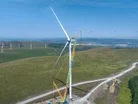
Vestas has fitted the UK's most powerful onshore wind turbine to date, a 6.2MW EnVentus machine, at the site in Dumfries and Galloway, Scotland.
The machine is the first of 44 units due to be erected across the 308MW project.
Once complete, Sanquhar II will rank as the UK's fourth-largest onshore wind farm, sitting alongside the nine-turbine, 32MW Sanquhar I site that CWP and Vestas built together in 2018.
Is bigger always better for contractors?
The installation reflects a wider industry shift toward heavier onshore machines, rather than a uniquely British achievement.
However, scaling up is not always the best call. Sulai Fahimi, Vestas' Head of Sales for Central Europe, says: "We firmly believe bigger does not automatically mean better."
"Project economics are under pressure, so we need to find the best business case for our clients that makes sense, also from a size perspective," he adds.
Fahimi said Vestas was instead focusing on industrialisation and standardisation to sharpen project economics, rather than chasing ever-larger ratings.
Manufacturers globally have nonetheless been raising turbine capacities to chase economies of scale, with Chinese suppliers moving fastest. Several now offer onshore turbines rated above 8MW.
Envision has unveiled a 10MW model, and state-owned CRRC is targeting beyond 14MW on land.
Western OEMs including Vestas, Siemens Gamesa and GE Vernova have so far kept onshore ratings within the 6MW to 7MW range.
Specialist contractors handle complex turbine installation

EnVentus is Vestas' flagship onshore platform, pairing a larger rotor with a higher-rated generator to draw more energy from a given site.
Vestas said the model was selected for Sanquhar II specifically for its power rating and operational flexibility, allowing it to capture the strong wind resource across Dumfries and Galloway and East Ayrshire.
The manufacturer has more than 600MW of EnVentus capacity under construction across the UK.
Delivering the Sanquhar II turbine has required a coordinated effort from several specialist firms, including BMS Heavy Cranes, wind turbine installers FairWind, heavy transportation firm Collett & Sons and Jones Bros Civil Engineering.
For contractors, turbine scale is a logistical question more than an engineering one. In densely populated markets such as Germany and the Netherlands, moving oversized components over bridges, through underpasses and along narrow rural roads has long limited how large onshore turbines can practically get.
Scotland's comparatively open terrain has made Sanquhar II an easier proving ground for larger machines than many other markets, giving contractors more room to manoeuvre heavy plant and equipment.
UK onshore wind gains political momentum
Though planning for Sanquhar II was a decade in the making, its delivery arrives at a pivotal moment for the UK government's net zero targets.
Landmark onshore projects like this one complement Britain's world-leading offshore wind fleet, which together with onshore capacity totals around 33GW installed nationwide, split roughly evenly between the two.
With onshore development sites more constrained than offshore, maximising output from each turbine matters increasingly to developers and, by extension, to the construction firms delivering these projects.
This makes Sanquhar II's performance one to watch closely from Westminster and Holyrood alike.
Officials have been enthusiastic about the project from the outset.
Speaking as construction got underway in 2025, Scotland's then-Energy Secretary Gillian Martin said: "Scotland's onshore wind sector is already creating significant economic opportunities, delivering jobs and attracting major investment across the country as well as supporting the drive to decarbonise our energy system and support the fight against climate change."
"This project is a key asset in supporting Scotland's onshore wind ambitions and will help secure our country's future as a renewables powerhouse," she added.
Company portals



Executives
Sulai Fahimi
Vice President, Sales Central Onshore