Can All-Electric Sites Transform Urban Deconstruction?
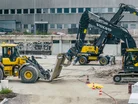
The establishment of the world's first fully-electric deconstruction site stands as a testament to collaborative innovation and commitment to sustainability.
Situated in Erlangen, Germany, this groundbreaking project is the result of a partnership involving Volvo Construction Equipment, Siemens and Metzner Recycling.
Together, they are powering a carbon-neutral vision for urban development.
The initiative aligns with Siemens’ €500m (US$586.8m) technology campus plan, setting the stage for circular construction techniques that prioritise ecological balance and urban efficiency.
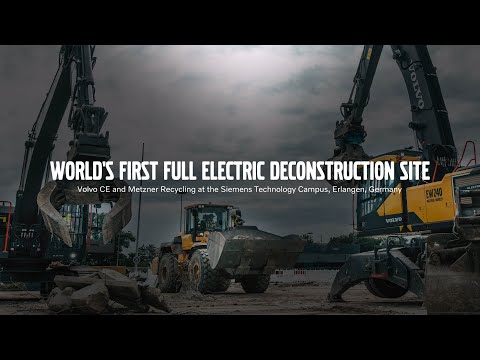
A collaborative effort in sustainable construction
Volvo CE took centre stage, collaborating with demolition experts Metzner Recycling by deploying an all-electric suite of construction equipment to redefine conventional demolition processes.
The 25,000 cubic-metre project site witnesses high-performance activities using compact, mid-size and grid-connected machinery.
This extensive operation achieves an emissions-free status by handling selective gutting, concrete crushing and material transport, all supported by emission-free vehicles from Volvo Trucks.
“Our transformation is no longer a vision, but a reality,” says Therese Schmitz-Hillebrecht, Head of Market Area Central Europe at Volvo CE.
“We don’t just develop electric construction machines, we accompany our partners on the path to an emission-free future. The fact that companies like Metzner and Siemens are joining us on this path is a strong sign.”
The use of electric fleets delivers tangible outcomes such as elimination of fossil fuel reliance, substantial reductions in CO₂ emissions, decreases in tailpipe pollutants and notable noise reduction – benefitting both the urban environment and its inhabitants.
Engaging with electric vehicle fleets
The integrated electric fleet includes the Volvo ECR18 Electric compact excavator equipped with a hydraulic breaker, optimised for interior concrete and masonry demolition tasks.
Complementing this is a Volvo L20 Electric wheel loader, transporting materials for efficient processing.
Exterior operations utilise a grid-connected Volvo EW240 MH Electric material handler and the Volvo EC230 Electric crawler excavator, significant for deconstruction and substance handling.
This comprehensive equipment set-up, steered alongside Metzner Recycling, meticulously dismantles three buildings encompassing nearly 25,000 cubic metres.
“The fact that we have now taken the first major step towards an all-electric, low-emission dismantling site as a technical standard is a huge success for us, the Metzner team, and our clients,” says Michael Metzner, Owner of Metzner Recycling.
“I get goosebumps when I think about what these machines make possible.
“Electric equipment could unlock urban projects currently held back by noise and pollution concerns. In fact, we’ve already introduced electric wheel loaders at some of our other sites.”
Inside, the compact machinery operates smoothly and quietly, aided by a Husqvarna DXR145/DXR305 demolition robot.
This set-up accomplishes tasks without emissions, negating the need for air filtration, which accelerates demolition activities.
Outdoors, large-scale electric machinery efficiently dismantles, crushes and loads materials into a Kleemann electric crusher and screening plant, with additional logistic support managed by a Volvo FM Electric hook lift and a Volvo FH Electric semi tractor.
The circularity principle in action
While executing demolition, nearly 12,800 tonnes of construction waste are sorted and processed, with an impressive 96% recycled into raw materials, furthering circular materials management.
“At Siemens Real Estate, we are committed to pushing the boundaries of sustainable construction and demolition,” says Christian Franz, Head of Sustainability at Siemens Real Estate.
“This groundbreaking electric deconstruction project boasts an impressive 96% recycling rate and is a testament to our commitment to achieving excellence in sustainability.
“Through strong collaboration and innovative thinking, the team has achieved exceptional results that directly support our company’s ambitious sustainability targets.
“This project illustrates how partnerships and determination can create a lasting impact and help shape a more sustainable real estate industry.”
This initiative not only introduces a technical advancement but also establishes a new model for collaboration among OEMs, contractors, real estate stakeholders and energy providers.
Fostering cross-sector alliances, it presents a scalable model for cleaner, quieter construction in urban settings, underscoring the importance of the transition towards sustainable development.