BMW Constructs Bavarian Battery Plant for EV Future

The heart of the BMW Group has been beating in Bavaria for over a century. Now, with the automotive industry moving towards a carbon-neutral future, the company is confirming its commitment to its home region through a significant new construction project.
To support the 2025 launch of the "Neue Klasse" – a new generation of vehicles designed to usher in a fully electric era – BMW is developing a dedicated high-voltage battery assembly plant in Irlbach-Straßkirchen, Lower Bavaria. The plant is needed to supply the vehicle manufacturing plants in Dingolfing, Regensburg and Munich.
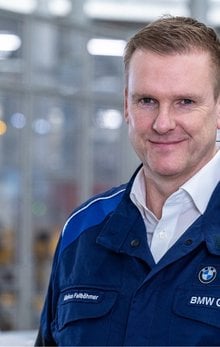
"We use lean, highly intelligent production processes that are already tested in our Bavarian pilot plants," says Dr Markus Fallböhmer, Senior Vice President Battery Production, BMW.
"We profit from short distances. We use digital twins to plan, train and optimise production processes. The ramp-up is a collaboration within the whole production network."
Strategic location for regional production
BMW’s commitment to Eastern Bavaria is rooted in retaining approximately 30,000 jobs while moving to a net zero future.
With existing factories lacking the required space for a project of this magnitude, BMW chose a 100-hectare industrial plot in Irlbach-Straßkirchen that met strict logistical and environmental criteria: it was flat, required no deforestation and sat outside water protection zones.
"At the end of 2022, we made the decision to start the project in February 2023," explains Sabrina Kugler, Overall Project Manager Plant Construction Irlbach-Straßkirchen.
"We purchased the land after looking at 20 other areas. A referendum took place on 21 September 2023. There was a clear and strong vote from citizens. Yes, BMW should build a new plant here."
Construction began in April 2024, aiming to create 1,600 positions and produce 1,000 batteries per working day.
Digital twins optimising plant construction speed
The development of the Irlbach-Straßkirchen site has progressed at what the company calls "Bavarian speed”, helped by advanced digital planning tools.
By creating a digital twin of the facility before the first stone was laid, BMW ensured that planning data and physical construction synchronised.
"We are very proud of what we have achieved since we started in April, 2024," says Sabrina. "We not only generate a digital twin already in the planning phase, we also track and synchronise a completed structure with the planning data.
“Having the final realised structure fed back in the digital twin provides proper service and maintenance during operation."
Innovative assembly powering the Neue Klasse
The Irlbach-Straßkirchen plant is a vital link in BMW’s "Local for Local" strategy, ensuring that high-voltage batteries are assembled near the vehicle plants they serve to reduce the carbon footprint of production. The plant focuses on the assembly of the "Gen-6" battery, which uses cylindrical cells.
"Our battery cells have a diameter of 46 mm and we use it in two different heights. One is 95 mm and the other 120 mm," says Markus.
"Compared to the prismatic cells of the former generation, our new cylindrical cells have a 20% increased energy density. We are convinced that we offer the optimum cell and pack to our customers worldwide. The Gen-6 offers a huge step forward in technology."
This technological leap is central to BMW's goal of ensuring more than half of its global sales are fully electric before 2030.

Revolutionary design for enhanced vehicle performance
The shift to the Gen-6 battery is a radical rethink of battery architecture. By moving away from traditional modules, BMW has created a slimmer, more integrated unit that enhances vehicle dynamics.
"With the new cells comes a completely new concept for the high voltage battery," Markus explains. "No modules, no struts and a more efficient and flat design, and one concept for our whole fully electric portfolio.
“The energy content of the pack is scalable through the rows of cells. The result is a more compact, slimmer and lighter battery with more energy inside." This "cell-to-pack" approach allows the battery to be integrated directly into the vehicle's cast structure, saving space and improving aerodynamics.
Advancing net zero through innovation efficiency
BMW is committed to the Paris Climate Agreement, aiming for net zero across the entire value chain by 2050. The Irlbach-Straßkirchen plant is a statement of intent, using zero-defect principles and AI-driven process optimisation.
"We produce with the zero defect principle, including continuous inline quality inspection," Markus says. "We use digital twins of production with a comprehensive AI database for process optimisation and employee training."
By streamlining the production process – specifically by eliminating cell coating and modules – the company reduces complexity while maintaining high standards.
Markus says: "For the sixth generation of high voltage batteries, we are adding five new production sites following the local for local principle. This means we place them as close as possible to the vehicle plants. The short distances reduce the CO2 footprint in vehicle production."
Circular economy and battery cell recycling
Sustainability at the new plant extends beyond the electric drive, encompassing the entire lifecycle of the battery. BMW identifies the high-voltage battery as the most valuable recyclable component of an EV and the company is researching in-house processes to keep raw materials within the value chain.
"The recycling of high voltage batteries at the end of their lifecycle is also coming more into focus," says Markus. "Therefore, we partner with leading recycling companies. Our partners convert the old batteries into high quality metals that can be reintroduced to battery production."
BMW is also developing a Cell Recycling Competence Centre (CRCC) in Lower Bavaria. Markus adds: "Thanks to our direct recycling process, residue from battery cell production and entire battery cells can be mechanically broken down into their valuable components."
Company portals

Executives
Dr. Markus Fallböhmer
Bereichsleiter Produktion Hochvoltspeicher, Energiemodul
Sabrina Kugler
Leitung Industrialisierung Produktion Hochvolt-Speicher Irlbach-Straßkirchen