
The Construction of Switzerland's Giant Foldable Solar Roof
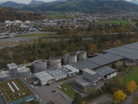
A large-scale project in Uetendorf, Switzerland, shows how renewable energy solutions can be integrated into existing industrial sites.
A large foldable solar roof system constructed by dhp Technology now covers the ARA Thunersee Wastewater Treatment Plant (WTP), demonstrating a method of embedding photovoltaic (PV) generation within an operationally sensitive environment. The installation is a notable example of dual-purpose infrastructure design.
For regions where land is scarce, building vertically or above existing structures is an attractive option. The project in the Canton of Bern uses the space above the wastewater treatment basins, turning a non-productive area into a renewable energy asset.
This approach contributes to decarbonisation targets without requiring new land. By generating power on-site, utilities can reduce their reliance on purchased electricity and mitigate exposure to volatile energy markets.

Dual-purpose design and land efficiency
The solar roof is positioned over the wastewater treatment facility’s pre-treatment and biological basins. These areas are among the most energy-intensive parts of the plant.
Across Europe, wastewater treatment accounts for more than 1% of total electricity consumption, making on-site generation a viable path towards reducing both operational costs and carbon footprints. The Uetendorf installation highlights how existing infrastructure can be repurposed to support renewable energy generation.
The system uses the patented HORIZON technology developed by dhp Technology. This design allows for extensive area coverage combined with structural adaptability.
The array transforms the facility into a productive renewable asset while maintaining its primary function. This model of integrating energy production with essential public services could be a blueprint for other land-constrained municipalities and industries looking to maximise their existing footprint.
Lightweight construction and material innovation
Spanning 20,000 square metres, the equivalent of three football pitches, the system has an installed capacity of 3,000 kilowatt peak (3 MWp).
Its projected annual output is between 3 and 3.4 gigawatt hours (GWh), which would be enough electricity to supply approximately 700 homes. The structure’s cable-supported lightweight design is a key engineering feature. It reduces material usage by around 50% when compared with conventional rigid solar installations.
Inspired by cable-car technology, the non-glass PV modules are suspended from high-tension cables. To improve site safety and reduce the complexity of elevated construction, large supporting trusses were pre-assembled at ground level before being lifted into place. This method of construction minimises disruption to the operational site below.
Automated retractability and operational access
A defining feature of the HORIZON system is its automated retractability. The solar roof can automatically fold into a protected storage position during adverse weather conditions such as high winds or heavy snow. This automated function reduces structural stress on the installation, which could extend the asset's life and simplify the initial engineering requirements.
The retractable nature of the roof also addresses a significant challenge posed by other PV solutions like floating arrays. Wastewater treatment basins require constant visibility and unimpeded access for maintenance, inspection and chemical dosing.
The HORIZON system provides 20-metre spans and a roof height of up to 7 metres, ensuring that workflows are not impeded. When access is needed, the system retracts completely, leaving the basins below fully accessible and demonstrating how renewable energy generation can coexist with the demands of a high-demand public utility.