Monumental's Robot Bricklayers Reframe Future of Building
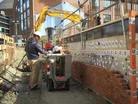
The construction industry’s labour crunch is opening the door to a new kind of subcontractor: robots.
Amsterdam-based Monumental, has raised US$32m in Series B funding to expand its autonomous bricklaying systems and prepare for a US launch, with backing led by Khosla Ventures.
For executives, the investment signals more than another robotics headline.
It points to a practical attempt to raise throughput in a sector where productivity has lagged for decades, while housing demand and project backlogs continue to strain margins and schedules.
Why builders are watching
The company says it has already completed walls for more than 100 homes, schools, community spaces and canal barriers in the UK and the Netherlands. It also cites a US construction-worker shortfall of 200,000 to 400,000 workers per month, underscoring the scale of the capacity gap it is targeting.
“The world simply does not have enough people to build what it needs,” says Salar al Khalafaji co-founder and CEO of Monumental. “Every robot we deploy expands the industry’s capacity to build, bringing a future of beautiful, affordable, bespoke buildings and infrastructure closer to reality.”
“Monumental is solving this by bringing robotics into the physical world, and the proof is already standing," adds Khosla Ventures founder Vinod Khosla added.
- 200,000-400,000: the total monthly shortage of construction workers in the US alone.
- US$32 million: the size of the Series B round, led by Khosla Ventures, to scale Monumental’s engineering team and fund its US expansion.
- 100+: the number of homes, schools, community centres and municipal structures the robots have already built across the UK and the Netherlands.
Why automation matters now
The broader case for automation is becoming harder to ignore. Monumental argues that construction represents roughly 13% of global GDP, yet it remains one of the last large industries to be transformed by modern automation.
At the same time, pressure on margins, tightening schedules and persistent labour gaps are forcing contractors and developers to look for new ways to add capacity without simply adding headcount.
That is where Monumental’s model is strategically interesting. Rather than asking builders to adopt a new process wholesale, the company frames itself as a specialist trade partner that can be brought onto a site when needed. For executives, that reduces some of the adoption friction that often slows robotics rollouts: no long-term fleet commitment, no need to build in-house robotics expertise, and no requirement to re-engineer the entire jobsite around the machine. There is also a strong signalling effect.
“Construction costs have exploded while the industry itself has barely changed in decades. Monumental is solving this by bringing robotics into the physical world, and the proof is already standing: canal walls, houses, a school... beautiful buildings, built at scale, don’t have to cost what they cost today," says Vinod.
How Monumental's system works
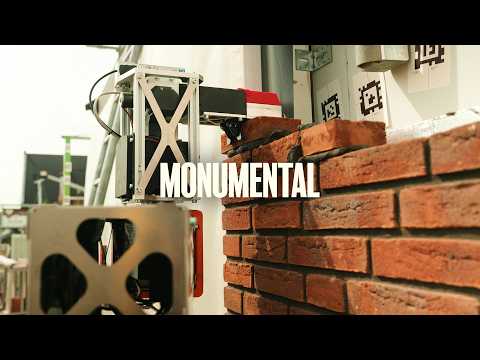
Monumental’s robots are electric autonomous ground vehicles equipped with computer vision, advanced sensors and robotic arms. The company says its proprietary AI software, Atrium, translates architectural blueprints into precise coordinates and manages the machines like a digital foreman, allowing them to place brick and mortar with millimetre-level accuracy.
That detail matters because site conditions are where many promising construction technologies struggle. Jobsites are crowded, uneven and constantly changing, so a practical robotic system has to handle disruption as well as repeatable output. Monumental says its machines are compact enough to move through tight spaces and flexible enough to work on active sites, which is a key requirement if the technology is to scale beyond showcase projects.
The startup also claims the model is already commercially viable. Its robots are worth up to US$100,000 each, but the customer does not buy the machine. Instead, Monumental delivers the robots to site, executes the work and bills for output, a structure that may appeal to contractors more comfortable buying results than owning novel hardware.
Construction costs have exploded while the industry itself has barely changed in decades,” says Vinod.
“Monumental is solving this by bringing robotics into the physical world, and the proof is already standing: canal walls, houses, a school... beautiful buildings, built at scale, don’t have to cost what they cost today.”
What it means for builders
The longer-term significance of construction robotics is strategic. Firms that learn how to integrate automation early may gain a cost, speed and delivery advantage. They may also be better positioned to respond when labour shortages intensify, when programmes become tighter or when clients demand faster delivery with more certainty.
That said, automation is not a universal fix. Not every project is suited to robotic execution, and not every site can support it easily. Irregular geometries, complex interfaces and changing conditions can still challenge machine-led workflows. The most effective use of robotics is likely to be selective rather than total, applied where the economics and repetition justify it.
For executive teams, the right question is not whether robots will replace the building workforce. It is where automation can create immediate value, how it can be introduced without disrupting delivery, and which parts of the project lifecycle are most ready for machine support. In that sense, robotic bricklaying is less about replacing construction as it has been done and more about extending what the industry can realistically deliver.
The future of building is likely to be hybrid: human expertise, digital planning and robotic execution working together. Autonomous masonry may be one of the clearest early signs of that shift.
Company portals



Executives

Salar al Khafaji
Founder/CEO
Vinod Khosla
Founder