
ReNew: Building Renewable Energy Capacity in India

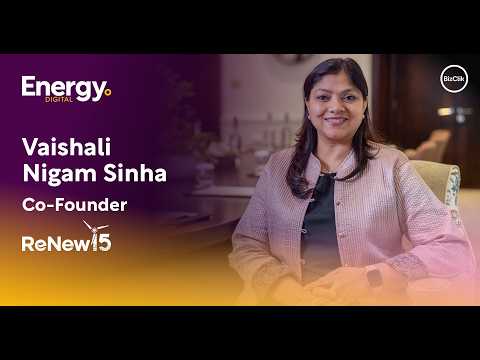
As Co-Founder of ReNew, India’s second-largest renewable energy company, Vaishali Nigam Sinha stands among the most influential leaders in the global energy landscape.
What makes her journey notable, however, is that her path into the sector was far from direct.
Before entering energy, Vaishali built a career in finance, working on Wall Street and in London after earning a master’s degree from Columbia University.
Over time, though, she began to feel a quiet dissatisfaction with work defined by transactions and financial outcomes.
What followed feels less like a career change and more like a moment of clarity. Underpinning her journey is a persistent question: what is a life for, if not to leave something better behind?
Today at ReNew, Vaishali leads the company’s sustainability function and chairs its charitable foundation. She also serves as President of the United Nations Global Compact Network India, a role of particular distinction.
She is both the first private sector representative and the first woman to hold the position, something she admits makes her feel “slightly proud”. Still, purpose, rather than pride, remains the defining thread of her story.
From India to Columbia
Raised and educated in India, Vaishali initially set her sights on a career in international relations. That ambition took her to Columbia University in New York, where she completed a master’s degree in Public Policy, supported by a scholarship from the American Association of University Women.
Her interest in environmental issues began early, even before sustainability became a mainstream concern.
“While I was in college, I was interested in sustainability,” she recalls. “It wasn’t really a thing then. But I really found it interesting and very calming. It was just a hobby, a part of my college work.” That early curiosity would later resurface with far greater significance.
For the next decade, however, she remained in finance, a world she describes as intellectually stimulating but personally intense. While rewarding, the experience eventually pushed her to confront deeper questions about purpose that she could no longer ignore.
The accidental founder
ReNew did not begin as a grand vision, but rather as a practical idea shaped by circumstance. Vaishali’s husband, Sumant Sinha, then CEO of Suzlon, was keen to build something independently.
At the time, sustainability was gaining attention but had yet to be seen as a viable standalone sector.
“People in government or in business thought it was a ‘nice to do’. But nobody thought you could actually make money from a sustainability-related business,” she explains. Rather than discouraging them, this uncertainty sharpened their resolve.
“If you’re very comfortable with something, the opportunity to create value isn’t as great,” she adds. “And if something isn’t really understood by the ecosystem, but you have the conviction, then perhaps you must go for it.” That conviction became the foundation of ReNew.
Vaishali herself did not initially see a clear role. “I thought there was no real role for me at ReNew. I hadn’t been an engineer, hadn’t had any experience in that space.”
At first, the venture was linked to a financial advisory platform, aligning with her background. But when Goldman Sachs invested, at five times the amount originally sought, the scale and ambition of the business shifted dramatically.
“Suddenly there was a huge amount to be done and we were a small team, so I got sucked into ReNew accidentally, not intentionally,” she says. “But as they say, the rest is history.”
Learning the terrain
The company’s early phase was anything but straightforward.
In energy, much like business more broadly, initial progress is often the hardest. Building the first 100 megawatts can be as challenging as earning a first million.
Creating an energy company from scratch required navigating realities far removed from finance—land acquisition, community engagement and on-the-ground execution.
“Acquiring land, engaging with communities, dealing with people, it wasn’t something we’d done in the past,” she says. “It was a steep learning curve.”
From the outset, values were central to how ReNew operated. “We were very clear that we wanted to do good business, but also in a good way, a clean energy business done in a clean way, with good governance, good community engagement and community values.”
The challenges extended to talent. The renewable energy sector was still nascent, with limited experienced professionals available.
“There was no track record of people in the sector because the sector didn’t exist,” Vaishali recalls. “So while we didn’t have a capital problem, which is what most people have, we did have an issue of finding people with the experience and understanding of how to get things done on the ground.”
The meteoric rise of ReNew
Since those early efforts, ReNew has grown at remarkable speed. From its first wind projects in Gujarat, the company now operates around 14GW of installed capacity, with more than 20GW in its development pipeline.
Yet Vaishali is careful not to equate success purely with scale. For her, the real achievement lies in helping shape the broader ecosystem.
“We were batting for the sector, not necessarily just the company and that’s what was helpful,” she says. “Not only for us to grow, but for the sector to grow.”
That philosophy aligned closely with India’s own renewable energy ambitions, which have expanded significantly—from 175GW to 250GW and now 500GW. ReNew has played a key role in translating these targets into tangible progress.
The company’s evolution reflects a strategic shift as well. What began as ReNew Wind Power became ReNew Power and eventually simply ReNew—signalling a move beyond electricity generation.
“An IPP is just using solar and wind to generate electricity,” she explains. “But we were moving from electrons to molecules as well.” This transition includes green hydrogen, battery storage, solar manufacturing, emissions management and partnerships with industrial and technology clients requiring clean energy solutions.
“It was really about decarbonisation,” she says. “We felt that moving from being an IPP to being a decarbonisation partner to various stakeholders was the opportunity.”
Realism over rhetoric
Vaishali approaches the energy transition with pragmatism rather than idealism. India’s 2070 net zero target, she notes, must be understood in the context of development priorities.
“You have a country with a lot of people below the poverty line, a lot of people without access to electricity. So it was about electricity access first, not just clean electricity,” she says.
As renewable costs declined, the transition gained economic momentum. “When the pricing curve bent in favour of renewables, it became an economic imperative,” she says.
This is why she challenges superficial approaches to sustainability. “Setting a net zero goal for 2050 means nothing if you’re not going to achieve it,” she says. “You have to set realistic goals.”
ReNew reflects this philosophy, with a net zero target of 2040 that has been validated by the SBTi and embedded into its business strategy.
Women, work and transition
For Vaishali, the energy transition is inseparable from inclusion. She speaks passionately about the role of women, arguing that meaningful climate action is impossible without them.
“You can’t solve these problems by leaving 50% of the population behind,” she says. “That’s a cliché, but it’s really true.”
Her perspective is grounded in observation. In rural India, women are already on the frontlines of climate impact, even if they are rarely included in decision-making.
“They do all the work. They face the consequences. If there’s a drought, they’re the ones who pack up the family and move,” she says. “They know what to do and how to solve problems. But they’re never consulted for solutions, at any level.”
At ReNew, this has translated into targeted initiatives—from reskilling women in Gujarat’s salt pan communities for solar roles to partnering with IIT Dhanbad in coal regions to create new career pathways for women and their families. The company has set a target of achieving 30% female representation in its workforce by 2030.
While proud of these efforts, Vaishali is equally encouraged by a generational shift in attitudes.
“It's really encouraging to see young people these days who are driven by purpose,” she says.
This, she believes, bodes well for the future of both ReNew and the wider climate movement. “When you hire young people from top institutions in India, it's really not only about money and wanting to be in the largest hedge fund. People genuinely care about companies doing good business. That's the good news.”
Company portals

Executives
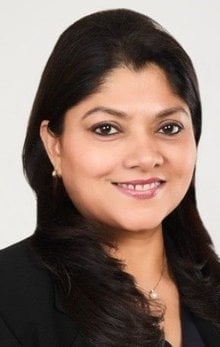
Vaishali Nigam Sinha
Co Founder and Chairperson Sustainability