A Major Project: Behind the Restoration of Hangar One
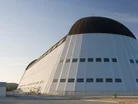
Built more than 90 years ago, Hangar One has served as a major landmark for the San Francisco Bay Area.
The old naval airship facility has sat for years in disarray, unusable due to chemical toxins used in original construction.
Rather than demolish the site, a major restoration has taken place, led by Google, NASA and backed by community support.
Now, Hangar One has been restored to its original form, marking a historic moment for the landmark.

A historical site
Hangar One, constructed in 1933, sits across eight acres on Moffett Field, in Mountain View, California. It was originally constructed as a West Coast base for the Navy’s “lighter-than-air” aviation program, was built to house the USS Macon.
This airship crashed two years later, but the hangar still found a use. For decades, the building was used to house training aircrafts, but was closed in 2003 due to toxins found in the wetlands near Moffett Field.
The toxins, identified as polychlorinated biphenyls, or PCBs, were traced back to Hangar One and the material used to make its external siding. Upon further investigation, toxic lead paint and asbestos were found throughout the building.
The federal Toxic Substances Control Act required the hangar to be closed to human use in 2003.
In an attempt to mitigate the contamination from the building, the Navy attempted to tear the hangar down, but strong community opposition prevented this from taking place. Instead, the Navy began plans to decontaminate the site, removing the roof, siding, windows, doors and other exterior parts before coating it with an epoxy.
This took three years and left the building as a skeletal frame. For years, this is how it sat, until Planetary Ventures – a subsidiary of Google – signed a lease with NASA to operate Moffett Federal Airfield, with the agreement that it would restore Hangar One.
Now, the project has been completed and the hangar has been restored.
“Today, we are honoring Hangar One’s past as a naval airship facility while embracing its future as a hub for technology and innovation,” said Eugene Tu, director of NASA Ames Research Center at the unveiling.
“Today, we don’t just reopen a building. We celebrate the revival of a legend.”
Sustainability, procurement and supply chain leaders won’t want to miss Procurement & Supply Chain LIVE, taking place at Navy Pier, Chicago, on April 21–22.
Co-located with Sustainability LIVE: The US Summit, the event unites senior decision-makers at a time when supply chains, sustainability and business performance are more interdependent than ever.
Secure your place now for The US Summit – group booking discounts available
A major project
The restoration was a significant project, due to both the scale of the project and the financial commitment needed to make it safe for use, while rebuilding it to its original form.
The restoration was completed in December 2025, including safe recladding of the siding and roof, alongside modern upgrades to plumbing and ventilation. The project paid homage to the old, while bringing it in to the modern era.
In order to safely remove the toxic chemicals, Planetary Ventures worked section by section, cleaning approximately 1.8 million square feet of steel elements. The steel frame was primed and repainted to look new, before being fitted with new siding, doors and windows.
In February 2026, Planetary Ventures received certification from the Environmental Protection Agency to confirm that the remediation had been completed.
"I’m excited to share that Planetary Ventures, a subsidiary of Google, has completed its restoration of historic Hangar One at Moffett Federal Airfield," explains Chris Alwan, Director of Corporate Real Estate at Google.
"We fully remediated and restored this iconic piece of aviation history, adding structural, electrical, and plumbing upgrades and a new exterior skin that replicates the building's original design while integrating bird-safe features and a new ventilation system.
"As of February 2026, we received National Park certification for our historic preservation efforts, alongside confirmation from the EPA that the hangar is fully remediated. This milestone wouldn't have been possible without the collaboration of NASA, the EPA, the Water Board, SHPO, our design and construction partners, elected officials [...] and our local mayors, councilmembers, and community.
"We are thrilled that Hangar One will continue its historic legacy for generations to come."
Though it is unclear what Hangar One will be used as, the restoration alone is a historic step towards preserving history for the region. Moreover, the construction project has ensured that it remains functional for whatever the future holds for the building.


Executives
Chris Alwan
Director, Corporate Real Estate
Eugene Tu
Center Director, NASA Ames Research Center