DEWALT Robotics: Accelerating Data Centre Construction
Data centre construction is emerging as a critical bottleneck as global demand for AI-driven computing accelerates. With facilities under development worldwide to meet growing infrastructure needs, the construction sector is facing mounting pressure to deliver projects faster without compromising on quality or safety.
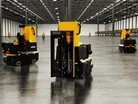
DEWALT has introduced a new robotic drilling solution developed in partnership with mobile robotics specialist August Robotics. The system is described as the world's first downward drilling, fleet-capable robot designed specifically for concrete drilling at scale.
The technology is already being piloted on live data centre projects for one of the world's largest hyperscalers, demonstrating the construction industry's growing reliance on automation to meet unprecedented infrastructure demands.
The solution has completed 10 phases of data centre construction, delivering drilling speeds up to 10 times faster than traditional methods and cutting overall construction timelines by as much as 80 weeks across those projects.
Powered by August Robotics' autonomous drilling and fleet orchestration platform, the robot enables consistent performance across complex and high-volume construction environments where precision and speed are increasingly non-negotiable.
Addressing hyperscale infrastructure pressure
The pressure on data centre construction has intensified as AI workloads drive unprecedented infrastructure investment.
According to industry analysis, hyperscalers now account for close to 80% of overall data centre demand, with industry-wide capital expenditure expected to reach US$7tn by 2030. This level of investment is creating a construction challenge that traditional labour-intensive methods might struggle to meet.
Bill Beck, President, Tools & Outdoor, Stanley Black & Decker, says: "Across the globe, hyperscalers, which account for nearly 80% of overall data centre demand are investing in infrastructure to power AI computing, with an estimated industry-wide capital expenditure of US$7tn in data centres by 2030.
"Our customers consistently emphasise that speed of construction is critical. The robotic drilling solution meets this need head-on through schedule acceleration, cost savings, near-perfect accuracy and enhanced jobsite safety. DEWALT's relentless pursuit of innovation to drive productivity is redefining how the world builds."
By focusing on one of the most time-intensive stages of the construction process, DEWALT is targeting a bottleneck that directly affects delivery timelines for new facilities and the ability of operators to bring AI capacity online quickly. For construction firms, this could mean securing repeat contracts in a sector where speed to completion is becoming a key competitive differentiator.
Precision at scale for critical builds
Concrete drilling is a foundational step in data centre construction, involving thousands of holes for server rack stops and the structural legs that support overhead mechanical, electrical and plumbing systems. Traditionally, this process is labour-intensive, physically demanding and subject to variability in both speed and accuracy, creating potential delays and quality control issues on site.
During pilot testing, the robotic solution has drilled more than 90,000 holes, achieving 99.97% accuracy in location and depth. This level of precision is particularly significant in hyperscale environments, where consistency is essential to maintaining build quality across large campuses and multiple sites.
The robot's fleet-capable design allows multiple units to operate simultaneously, unlocking greater drilling capacity without a proportional increase in labour. This approach supports standardisation across projects while reducing dependency on scarce skilled labour, a challenge that continues to affect construction productivity across multiple sectors.

Efficiency gains and safety improvements
Implementation of the robot has delivered measurable efficiency gains across data centre projects. In addition to saving 80 weeks across 10 builds, the system has reduced the cost per hole by increasing output and minimising rework. For construction companies managing tight margins and aggressive schedules, these improvements could translate into significant cost savings and enhanced project predictability.
Autonomous drilling also improves jobsite safety by reducing worker exposure to vibration, dust and repetitive strain. These factors are increasingly important as data centre construction scales up globally and operators seek to improve safety outcomes alongside productivity.
The robot integrates into DEWALT's broader data centre construction ecosystem, which includes PERFORM AND PROTECT tools and technologies designed to mitigate vibration and dust while enhancing user control. It also complements the company's ICC anchoring solutions, creating a more comprehensive offering for critical infrastructure builds.
As AI continues to reshape the data centre landscape, automation and robotics are playing a growing role in enabling faster, safer and more predictable construction. DEWALT's downward drilling robot highlights how advanced tooling can support the next wave of hyperscale expansion while addressing some of the construction sector's most pressing delivery challenges.
Company portals


Executives
Bill Beck
President - Tools & Outdoors