What's the Link Between Meta, AI & the US Concrete Industry?
Meta is streamlining the US construction industry by applying advanced AI to cement and concrete production.
According to a 30 March update on the Meta Engineering blog, the company is using "adaptive experimentation" to revolutionise material development. This method leverages Bayesian optimisation to efficiently sift through countless chemical formulations and identify the most effective mixtures.
In the post, it outlines how across the US, roughly 400 million cubic yards of concrete is poured – which is around enough concrete to pave a two-lane highway that circles the Earth multiple times.

Bridging the gap in domestic supply chains
Construction is the lifeblood of critical infrastructure, bridges, data centres, highways and homes. But, while the US is the producer of most of its own ready-mix concrete, the country imports nearly a quarter of the cement that makes it.
That is where Meta’s AI is looking to step in to help make a change.
Designing concrete is a delicate balancing act. A standard mix requires a precise blend of cement, aggregates, water and chemical additives to meet competing demands for strength, workability, cost-effectiveness and environmental impact. Traditionally, achieving this balance has relied on slow, expensive trial-and-error and the intuition of seasoned engineers, a manual process that struggles to keep pace with modern needs.
While most ready-mix concrete is made in the US, the industry faces a significant hurdle: cement imports. Currently, about 20-25% of the cement used domestically is imported, which can stifle local manufacturing and job growth. Relying on international sources also introduces inconsistencies, as foreign cement often doesn't align with strict US environmental and performance standards.
The push for reshoring, bringing production back to the US, is vital for economic health:
- Job creation: Since 2020, reshoring and foreign investment have added over 1.1 million jobs to the US workforce.
- Economic multiplier: Manufacturing has a massive impact; every US$1.00 spent adds US$2.69 to the national economy.
- Sector value: The cement and concrete industry contributes over US$130bn annually and supports 600,000 jobs, yet domestic producers still miss out on the 23% of demand met by imports.
To capture more of this value, US producers want to swap imported materials for domestic ones. However, cement chemistry is highly variable; a formula that works with one source may fail with another. To successfully transition to US-made materials, the industry needs a way to validate new formulations rapidly, moving away from months of lab testing and toward a more agile, data-driven approach.
Real-world impact across the United States
Meta’s innovations in concrete design have already earned significant industry recognition, including the 2025 Building Innovation Award for Best Partnership and the 2025 Slag Cement Award for Sustainable Concrete Project of the Year.
These honours, shared with partners like Amrize and the University of Illinois at Urbana-Champaign, reflect a shift from theoretical research to practical application. The influence of these AI models is now expanding through direct collaborations with large-scale manufacturers and software providers across several key states.
Illinois: Scaling domestic production
In Chicago, Meta has embedded its AI research into the operations of Amrize, the largest cement and concrete manufacturer in North America. With 18 cement plants and hundreds of ready-mix sites, Amrize provides the industrial scale necessary to prove that AI can transform mix design at a national level.
To support this transition toward self-reliance, Amrize recently introduced a Made in America label and announced nearly US$1bn in capital investments for 2026 to expand domestic production. At the American Concrete Institute Spring Convention, Meta and its partners are debuting BOxCrete, a robust new AI model capable of predicting concrete slump and navigating "noisy" real-world data. Alongside this model, Meta is releasing the foundational data from its Rosemount project, which currently stands as the most comprehensive open-source dataset for concrete performance available to the public.
Minnesota: Strengthening critical infrastructure
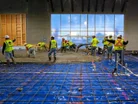
The practical power of the BOxCrete model was demonstrated during the construction of Meta’s data centre in Rosemount. In collaboration with Amrize and Mortenson, researchers used the AI to develop a specialised mix for the massive foundation slabs that support heavy server and cooling systems. This optimised formula, created entirely from domestic materials, reached full structural strength 43% faster than the original design while simultaneously reducing the risk of cracking by nearly 10%. Because the data confirmed the mix met all rigorous structural requirements, it has now been qualified for broader use across the entire data centre campus.
Pennsylvania: Open-source integration
Meta’s commitment to industry-wide advancement reached a milestone in 2023 when it released its concrete optimisation framework as open-source software under the MIT licence. This move has allowed commercial software companies to integrate advanced AI into the daily workflows of concrete producers. For example, the Pennsylvania-based enterprise platform Quadrel has adapted Meta’s framework to power its own suite of tools for the ready-mix industry. By embedding these models into daily quality control and operations, Quadrel enables producers to use field test results to continuously improve their mixes. This integration ensures that AI-driven design is no longer a niche research project but a standard component of modern American infrastructure.
The mechanism of adaptive experimentation
Meta’s AI model for concrete accelerates the integration of domestic materials into construction mixes through a sophisticated approach known as adaptive experimentation. At the heart of this process is the Adaptive Experimentation (Ax) platform, which utilises Bayesian optimisation to intelligently navigate millions of potential concrete formulations.
Rather than relying on random testing or human intuition alone, the AI creates a strategic roadmap for development.
The system begins by learning from historical mix designs, laboratory results and existing performance metrics to understand established chemical behaviours. It then proposes high-potential candidates, suggesting new formulations most likely to meet specific targets while comparing the performance of US-made materials against foreign alternatives.
Users can input technical constraints and specific ingredients upfront, ensuring the AI operates within practical engineering bounds. Finally, the model refines itself with every physical test; each lab result feeds back into the system to improve future predictions, creating a continuous loop of automated optimisation.
While this AI-driven approach does not replace essential steps like lab validation, field trials or engineering sign-off, it dramatically increases the speed of discovery. It allows engineers to bypass hundreds of dead-end formulas and find superior starting points with significantly fewer physical tests.
Meta’s work in this field is part of a larger commitment to applying machine learning toward measurable, real-world impacts. While current collaborations with Amrize, the University of Illinois and software providers like Quadrel represent the initial wave of adoption, the long-term goal is a fundamental shift in how the American construction industry approaches material design.
Over the coming years, Meta plans to expand its partnerships to develop even more advanced AI tools for the construction sector. As industry platforms like Quadrel integrate the BOxCrete model, AI-optimised design becomes a standard resource for producers, fitting seamlessly into their existing workflows without requiring specialised technical overhauls.
Ongoing academic research with the University of Illinois Urbana-Champaign will continue to explore how AI can tackle broader challenges, including deep sustainability goals and enhanced material performance.
By lowering the technical barriers to adopting domestic materials, Meta is empowering American producers to remain cost-competitive, lower their carbon footprint and strengthen supply chain resilience through data-driven innovation.