
Scania's Sleipner: Built for Construction and Mining
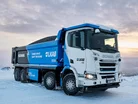
Scania has joined forces with Swedish mining firm LKAB to introduce a fully-electric 8x4 heavy tipper into operations at the Malmberget iron ore mine in northern Sweden.
This vehicle, named “Sleipner” after the eight-legged horse from Norse mythology, has been specifically designed and built for use in construction and mining operations. It becomes the first electric truck from Scania to feature two steerable front axles, resulting in enhanced manoeuvrability and load capability in harsh underground environments.
Developed as part of Scania’s modular electric platform, Sleipner offers greater load capacity and improved stability. These features are tailored for the demanding terrain and steep gradients that characterise the Malmberget mine.
Peter Gustavsson, Project Manager for Electrification of Mobile Machines at LKAB, says: “If it performs as expected, we will have a fully fossil-free solution for transporting waste rock in truly demanding mining operations.”
LKAB moves more than five million tonnes of waste rock every year across its sites. Converting this high-volume haulage to an electric model introduces a real potential for CO₂ emissions reduction, contributing towards the company’s broader target of a fossil-free value chain.
Electrification under real mining conditions
The new electric tipper operates on a five-kilometre route between a chute loading station and a backfilling site at Tingvallskulle. Along this route, it faces a 250-metre elevation gain, adding stress to both drivetrain and battery performance.
The trial provides Scania engineers with an opportunity to study traction, braking, driver handling and battery management in an operational environment.
The truck replaces a diesel model of equivalent size and carries a 38-tonne payload. It runs on two MP20 battery packs with a combined installed capacity of 416 kWh. A 400 kW EM C 1-4 electric motor delivers propulsion, offering power levels comparable to combustion engine trucks, but without engine noise, exhaust emissions or cabin vibration.
The double front axles are steerable, which increases stability and turning precision when the truck navigates narrow underground tunnels or climbs loaded inclines. This makes the vehicle especially suited to both underground and open-pit applications where space and traction are at a premium.
Tony Sandberg, Head of Scania Pilot Partner, says: “Partnerships like this are essential for learning and accelerating progress.”
The mining sector presents particular challenges for electrification, especially in terms of payload, battery reliability, charging access and mechanical durability. Scania has built Sleipner to confront these challenges directly, applying its experience in truck electrification to one of the most demanding industrial environments.

Based on in-field learning
Sleipner is not the first electric tipper Scania has deployed at Malmberget, with a previous 6x4 electric truck entering service at the same mine in 2022.
The newer 8x4 model builds on the learnings from that deployment and demonstrates how electric powertrains can evolve to meet the extreme demands of active mining operations.
Each deployment allows Scania to collect data from real operations. Battery durability, charging patterns, mechanical wear and operator feedback all feed into design improvements – an iterative approach helping shape a mining-specific electric platform capable of scaling across multiple sites.
Tony adds: “Each new truck we put into operation helps us and our customers understand how to scale electrification across the toughest environments. This vehicle is just the start of many more mining solutions to come.”
The collaboration with LKAB serves two purposes: to support the customer’s carbon reduction ambitions and to test how Scania’s electric vehicles perform in continuous, heavy-duty work cycles.
For LKAB, the goal is to develop a mining transport system that aligns with its fossil-free strategy. For Scania, the ambition is to create electric trucks that not only match diesel performance but exceed it in reliability, comfort and environmental impact.
Sleipner – as both a product and platform – shows how full-scale electric trucks can be deployed in daily mining work without compromising load capacity or uptime. In doing so, Scania and LKAB take another step in applying electric transport to the construction and mining industries where emissions, safety and efficiency are under constant pressure.
Company portals

Executives
Tony Sandberg
Vice President Scania Pilot Partner
